Short answer
Is the folklore dinner show in Bukhara worth it?
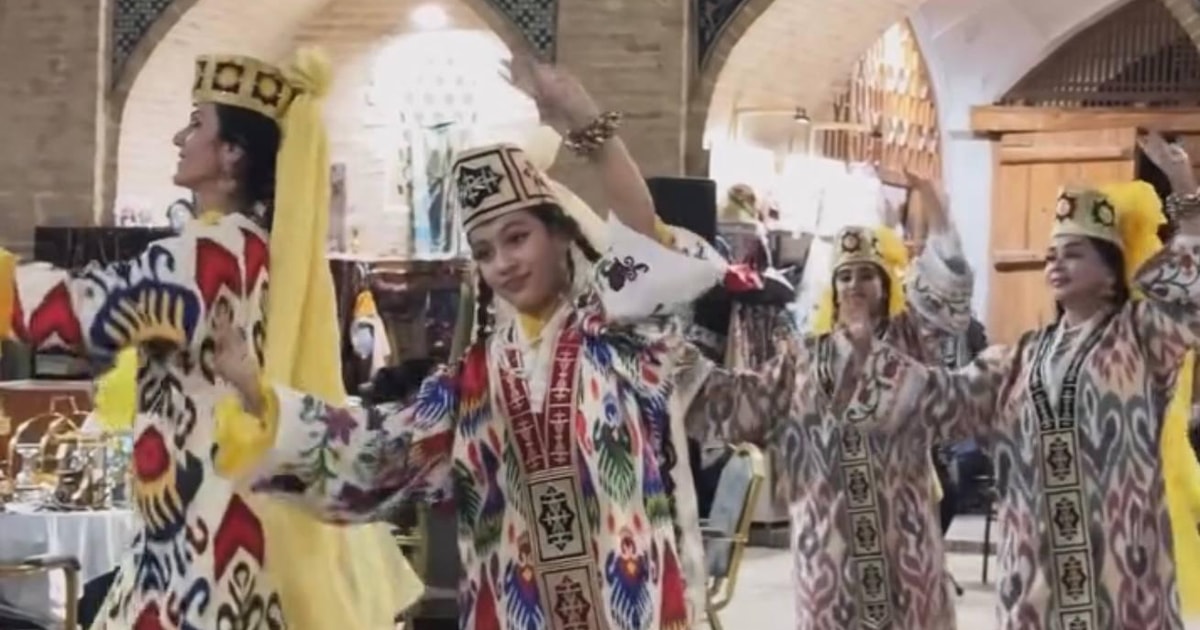
Yes. You sit down to Uzbek songs, folk dances and a parade of traditional Bukharan costume in a madrasah courtyard from the 1620s, a few steps from Lyabi Hovuz, the old pool at the heart of the city. Artists from the Bukhara Philharmonic perform, dinner and Eastern sweets are part of the evening, and the whole thing is built to be easy: one hour, one courtyard, one table. Its guest score is 3.5 out of 5 across 29 reviews, a modest result, so book it for the setting, the music and the costumes, and add one of the walking tours if you want a long, detailed look at the city.
Why the evening works
The setting
The courtyard belongs to the Nadir Divan-Begi Madrasah, which Wikipedia dates to 1622 and places on the east side of the Lyab-i Hauz pool. The pool is one of the few that survive from a city that once relied on them for water, and old trees and two more historic buildings frame it. You are dining inside the UNESCO-listed historic centre, not beside it.
The music and dance
The booking page names artists from the Bukhara Philharmonic and promises traditional Uzbek songs, dances and music. It does not list the programme, so treat the repertoire as a pleasant surprise rather than a set list.
The clothes
A fashion show of traditional Bukharan clothing runs alongside the performance. Bukhara has long been known for silk, ikat and gold embroidery, so the costume parade is a natural fit for the city.
The table
Uzbek cuisine and Eastern sweets are part of the evening. The booking page gives no menu, so message ahead if you have dietary needs.
A seasonal note
The show runs daily from mid-March to November. Outside those months there is no evening to book, so check the calendar for your dates. If your trip falls in winter, the walking tours below run on their own schedules.
Seven things behind the evening
Seven threads behind the evening
Around the courtyard stand a pool, three buildings, a folk trickster, a Silk Road city, a musical tradition, a wardrobe and a national dish. These seven notes condense reference articles, and none of them describes your own night.
-
The pool
A hauz that outlived the others
Wikipedia says the name Lab-i Hauz means 'by the pool' in Persian. Until the Soviet period such pools were the city's main water source, and most were filled in during the 1920s and 1930s. This one survived because it sits at the centre of a 16th- and 17th-century ensemble that has changed little since. The pool measures 46 by 36 metres, with stone steps descending to the water.
-
The madrasah
A caravanserai that became a school
The Nadir Divan-Beghi Madrasa is dated to 1622. Wikipedia says it was first planned as a caravanserai, but Emir Imam Quli Khan declared it a madrasa at its inauguration. Nadir Divan-Beghi, a vizier and the emir's uncle, is the figure most tied to the ensemble, and a khanqah, a Sufi lodging house dated to 1620, stands on the west side.
-
The trickster
Nasreddin, who stands by the pool
Wikipedia notes that a statue of Nasreddin Hodja stands in the Lab-i Hauz complex. The humorous folk character is known across Central Asia and beyond, with stories often built around his donkey. Uzbeks consider him an Uzbek who was born and lived in Bukhara, while Turkish sources link him to Aksehir, and the article says his birthplace and historicity remain unresolved.
-
The city
A Silk Road capital under UNESCO
Wikipedia says Bukhara's place on the Silk Road made it one of the most prosperous cities of Transoxiana. By 850 it was capital of the Samanid Empire and known for its libraries. UNESCO inscribed the Historic Centre of Bukhara in 1993, and the Wikipedia article counts about 140 architectural monuments, among them the 45.6-metre Kalyan Minaret.
-
The music
Shashmaqam, the six modes
Wikipedia describes shashmaqam as a refined Central Asian genre whose name means 'the six maqams', with lyrics drawn from Sufi poems about divine love. It says the genre may have developed in Bukhara. Its instruments include long-necked lutes and the dayra, a frame drum with jingles, and UNESCO inscribed it in 2008. The booking page does not say it features in the evening.
-
The clothes
Ikat, caps and gold thread
Wikipedia says ikat is made by resist-dyeing the yarns before weaving, and that in the 19th century the Silk Road oases of Bukhara and Samarkand were known for fine silk ikat. The Uzbek doppi is the national headwear, often embroidered. Zardozi, gold-thread embroidery whose Persian name joins 'gold' and 'sewing', is said to have been present in Uzbekistan since ancient times.
-
The table
Plov and the tea that goes with it
Wikipedia calls plov the national dish of Uzbekistan and says UNESCO inscribed it in 2016. Rice is simmered in a meat-and-vegetable stew called zirvak, traditionally in a kazon over an open fire. Green tea is the national hot drink, offered to every guest as a sign of hospitality. The booking page promises Uzbek cuisine without naming dishes.
Condensed from Wikipedia on Lab-i Hauz, Bukhara, the Historic Centre of Bukhara, Nasreddin, Shashmaqam, Ikat, Doppi, Zardozi and Plov. They set the scene only; the programme is not covered.
A timeline from the Samanids to the courtyard tonight
Eight dates from the Samanids to the courtyard tonight
- By 850
Bukhara is the capital of the Samanid Empire and a major intellectual centre of the Islamic world
The source: Wikipedia's Bukhara article
- 1568–69
The Kukeldash Madrasa is built on the north side of the pool, the largest madrasa in the city with 160 cells
The source: Wikipedia's Lab-i Hauz article
- c. 1620
The Nadir Divan-Beghi khanqah, a Sufi lodging house, is built beside the pool
The source: Wikipedia's Lab-i Hauz article
- 1622
The Nadir Divan-Beghi Madrasa is completed, planned as a caravanserai but declared a madrasa by Emir Imam Quli Khan
The source: Wikipedia's Lab-i Hauz article
- 1920s–30s
Most of Bukhara's hauz pools are filled in; Lab-i Hauz survives
The source: Wikipedia's Lab-i Hauz article
- 1993
UNESCO inscribes the Historic Centre of Bukhara, reference 602
The source: Wikipedia's Historic Centre of Bukhara article
- 2008
Shashmaqam is inscribed on UNESCO's intangible heritage list for Tajikistan and Uzbekistan
The source: Wikipedia's Shashmaqam article
- 2016
UNESCO inscribes the culture of plov on the intangible heritage list
The source: Wikipedia's Plov article
The booking page, line by line
The listing, point by point
This section paraphrases the booking page as read on 20 November 2026. Whatever that page omits is omitted here too, and your confirmation has the final say.
See open evenings ↗The from-price here was read on the day this page was written. What you pay depends on the date you choose.
- The evening
- Dinner and a folklore show in the courtyard of the 17th-century Nadir Divan-Begi Madrasah on Lyabi Hovuz, running for about an hour.
- The performers
- Artists from the Bukhara Philharmonic perform traditional Uzbek songs, dances and music.
- The costume show
- A fashion show of traditional Bukharan clothing is part of the programme.
- The dinner
- Uzbek cuisine and Eastern sweets. No dishes, drinks or dietary choices are listed.
- The season
- The show runs daily from mid-March to November. There are no evenings to book outside those months.
- Getting there
- The ticket does not cover travel to or from the venue, so you arrange your own journey to the courtyard.
- Booking notice
- The calendar asks you to book at least ten hours ahead, so a same-day plan needs an early start to the day.
- Changing your mind
- Free cancellation applies and nothing is taken at booking. Terms for your date sit in the calendar. Wheelchair access is marked on the page.
A folklore dinner or a day on foot
A folklore dinner or an Old Town walking tour?
More of Bukhara around the evening
More Bukhara bookings to pair with it
The folklore dinner fills one evening. Beside it sit two guided walks through the old city, rated by hundreds of guests, and a two-day trip to Aydarkul Lake and a yurt camp.
- See dates ↗
Dinner and folklore show at Divan Begi Madrasah
An hour of Uzbek songs, dances and a Bukharan costume show in a 17th-century madrasah courtyard, with Uzbek cuisine and Eastern sweets.
- See dates ↗
Ancient city walking tour in a small group
A guided walk of three and a half to four hours through Bukhara's UNESCO-listed old centre, rated by nearly seven hundred guests.
- See dates ↗
Old Town walking tour with 16 stops
A three-and-a-half-hour small-group walk that takes in the Lyabi Hovuz ensemble, the Magoki-Attori Mosque and the Kalyan Minaret.
- See dates ↗
Aydarkul Lake and yurt camp, 2 days
Two days out of the city with a yurt camp at Aydar Lake, starting from Bukhara or Samarkand.
Also bookable in Bukhara
Sorting out the evening
Four things to settle first
Check the season
The folklore evening runs daily from mid-March to November. Pick a date inside that window and the calendar will show what is on sale.
Book ahead of the day
The calendar asks for at least ten hours' notice, so reserve the night before or earlier in the day.
Make your own way there
The booking page includes no transport. Lyabi Hovuz is a well-known square, so ask your accommodation how to reach it and when to set off.
Pair it with a walk
The show is an hour. A guided walk by day gives the context, and a plov or tea stop fills the gap before the courtyard evening.
Six deeper reads
Six reads on the pool, the madrasahs and the table
- Start here Is the folklore dinner show in Bukhara worth it? A courtyard evening on Lyabi Hovuz, weighed up An hour of Uzbek song, dance and costume in a 17th-century madrasah courtyard, set against what the booking page promises and what the rating says. Read →
- The comparison A folklore dinner or an Old Town walking tour: which Bukhara day? A courtyard evening of song and dance set beside a guided walk through the old city, compared on length, pace, rating, season and who each suits. Read →
- The pool Does it help to know Lyabi Hovuz before the dinner? The pool and its three buildings A short guide to the Lab-i Hauz ensemble: the pool, the Kukeldash Madrasa, the khanqah and the Nadir Divan-Begi Madrasa where the evening is set. Read →
- The city Will knowing Bukhara's Silk Road history improve the evening? A short guide to the UNESCO city Bukhara as a Silk Road capital, a Samanid centre of learning and a UNESCO World Heritage city, explained in a few minutes. Read →
- The clothes What will the Bukharan costume show draw on? Ikat, embroidered caps and gold thread A short guide to the textile traditions behind the costume show: silk ikat, the doppi cap and zardozi embroidery. Read →
- The table What does an Uzbek dinner look like? Plov, tea and sweets explained before you book A short guide to Uzbek cuisine: plov and its UNESCO listing, tea as hospitality, and the sweets the booking page calls Eastern. Read →
FAQ
What guests ask before booking
Is the folklore dinner show in Bukhara worth it?
Yes. You get Uzbek songs, folk dances and a costume parade performed by artists from the Bukhara Philharmonic, with dinner and Eastern sweets, in the courtyard of a 17th-century madrasah on Lyabi Hovuz. Guests rate it 3.5 out of 5 from 29 reviews, so go for the setting, the music and the costumes.
How long does the evening last?
About one hour, according to the page. Evenings on sale are listed in the calendar.
Does it run all year?
No. Daily performances run from mid-March to November, so from December to early March there is nothing to book. The calendar lists only evenings on sale.
Who performs?
The booking page names artists from the Bukhara Philharmonic, performing traditional Uzbek songs, dances and music, plus a fashion show of traditional Bukharan clothing.
What does the dinner include?
The booking page promises Uzbek cuisine and Eastern sweets. It does not list the dishes, the drinks or any dietary options, so if you are vegetarian or have allergies, ask through the booking message before you reserve.
Is transport included?
No. Getting to and from the courtyard is up to you, since the ticket does not cover travel. The venue is the Nadir Divan-Begi courtyard on Lyabi Hovuz.
How much notice does the booking need?
The calendar asks for at least ten hours' notice, so a same-day booking only works if you reserve early in the day.
Is the evening wheelchair accessible?
The page marks wheelchair access but says little about the courtyard itself, so message ahead if you need specifics.
What if my plans change?
Cancelling is free, and nothing is charged when you book. Your date's cancellation terms appear in the calendar.
Is this site the madrasah or the show's own page?
No. This is an independent guide. The madrasah, its performers and the company running the evening have no connection to it, and the booking itself is handled by GetYourGuide.